
Everything RingGrip Fixture teams ask about specs, fit and use. Honest numbers matched to real South African handling, from Gauteng to coastal plants.
Use Cases · Notes · Contact us.
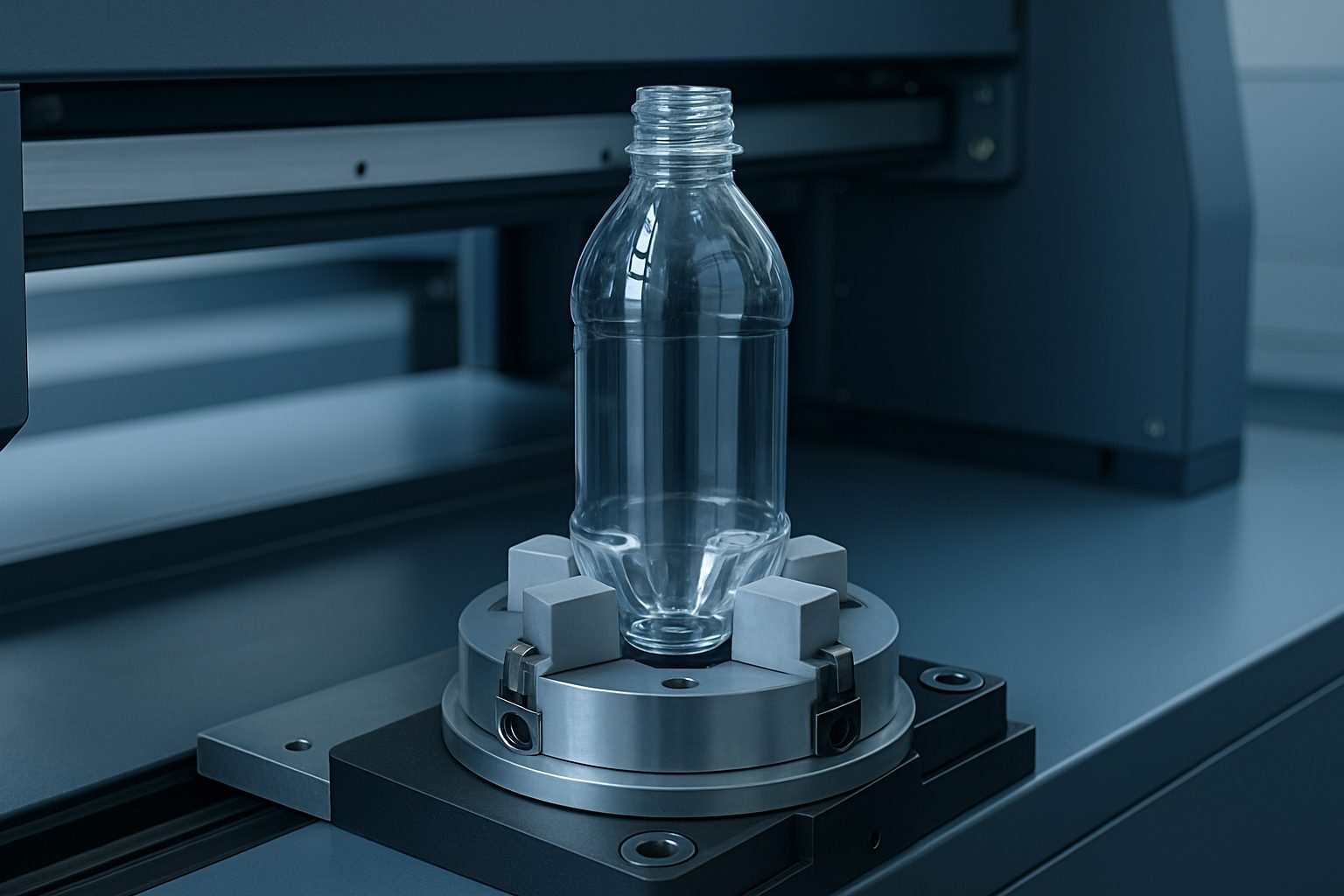
| Jaws | Soft silicone / POM |
|---|---|
| Swap | < 2 min |
| Bottles | 45,95 mm |
| Marking | None on contact |
| Compat | UV Cylinder Pro |
Use our contact form for a tailored footprint.
The RingGrip Fixture keeps bottles steady for UV decoration, letting operators print neck-to-base with no sliding or wobble. Its build suits craft lines, boutique skincare, and anyone running short or mixed bottle batches. If your floor carries heavy glass, PET, or tin designs that shift in the fixture, this rig solves that without fuss. Many teams we see in Germiston or Gqeberha use it to bridge the gap between hand-applying wraps and full conveyor lines. If your line is moving to direct-to-bottle print in batches of 20 to 600, this is the fixture made for that pace.
If you run a fully automated, high-volume line with robotic pickers, or your bottles never change shape, a fixed rail or star-wheel system may suit you better. For odd shapes, limited runs, and setups where staff swap between whisky and lotion bottles, the RingGrip Fixture is the fit.
Each RingGrip Fixture clamps bottles using a flexible tension ring that can take knocks from hurried hands, Highveld dust, or a quick shift between glass and PET. The footprint fits most 600 mm benches, and the frame is powder-coated to resist coastal humidity in Cape Town or Durban. It’s designed to survive stop-start load-shedding, rough mains, and the odd unplanned move, so if you reconfigure from a corner in Bloemfontein to a larger bay in Polokwane, the mounting simply rebolts.
Cleaning the fixture means a rinse and a wipe, no special tools or solvents. Operators don’t need special training to adjust tension or swap inserts, and if a part wears out, replacements are listed in our RingGrip Fixture fixtures & accessories section. For most teams, the only prep is levelling the bench and checking cable routing if your print bay is shared with other gear.
Suppose your Germiston studio runs both 375 ml spirit bottles and tapered 200 ml serums. The operator swaps out the ring insert (which takes about two minutes), snuggs each bottle with a half-turn, and lines up a test print. Under load-shedding, there's no need to recalibrate after power returns, as the tension holds. Once the batch flips from spirits to serums, a new insert and tension tweak get the crew back on track within the same shift. This routine works for teams who need to switch products midweek without delays that eat up production windows.
If you’re not sure which insert, tension, or mounting option matches your next mixed run, email our team at our contact form. Pictures of the bottles and quick dimensions help us suggest which kit to start with.
Before contacting us, get your brief sorted. List your constraints up front, whether it’s the bottle diameter, batch size, bench space, or a tight delivery window. If you’ve got photos of your current print bay or the bottles you run, attach those. If your drawings or spec sheets are still rough, that’s fine for a first pass. This helps our team answer with practical suggestions instead of generic catalogues.
Once you have these details, send them through our contact form. We’ll use your info alongside our internal notes from previous installs, so you aren’t repeating old mistakes. If you want to check compatible finishes or UV inks, see our Finishes page.
Most trouble comes when the constraint isn’t written out before ordering, a missed bottle size, or forgetting that your floor floods twice in summer. Teams sometimes pick the wrong insert or tension, thinking they can make do, only to rush a fix when it rubs off on the shelf. Highveld teams often underestimate local dust and vibration, while coastal operators forget how quickly uncoated steel corrodes. Mixing aluminium and PET without checking print adhesion causes more rework than most owners expect.
One small note: its easy to overthink the fixture when a simple tension tweak is all that is needed. We recommend closing your spec list with the operator on hand before emailing. For more day-to-day tips, browse our Notes or see related Use-cases.
Verified Google reviews
Our contact form · Sunnyrock applications lab